Greetings, reader. I don't think there are many of you left, but that's ok. Those of you who are here and reading this: know that I appreciate it.
It seems that whenever I don't have anything particular to talk about, I always fall back on film as a good topic. Hey, I always have something to say about it...so here it goes.
As Tom Hanks says in the excellent Apollo 13: "Gentlemen, what are your intentions?" I've been spending a lot of time thinking about this question in relation to film, its meaning, and my potential place in it.
As related to that, I have had some interesting experiences lately in this area. I picked up a book from the library the other day--a collection of writings by the famous film critic, Roger Ebert. I enjoy reading Ebert; he is a very good writer when he likes a movie, and a very funny writer when he does not. Anyway, this book included Ebert's reviews for what he considered the 50 best movies of the 20th century (or something like that). To my shame, I had not seen a single one (they were not particularly prominent)--however, reading about them was an unusual experience. Ebert's work tossed around some of the greatest names in the business: Steven Spielberg, Martin Scorsese, Oliver Stone, Francois Truffaut, etc. (I have seen movies by these people, just not the ones Ebert selected) He described these men and their work with great detail. It is hard to describe the feelings I had in reading this--maybe I could compare it to an aspiring artist studying da Vinci. Deep down, it is the realization that film is an art. I mean, in way more than the obvious sense.
The realization that film is an art leads to two different emotions, for me anyway. The first is feeling slightly intimidated, slightly inadequate. When you realize just how deep the art of film runs--as with any art--just how subtle and profound its innovations, all the thought and work that goes into every moment of a well-made film, you start to wonder, "could I even do this?" The arts are a tricky thing, they bring in a difficult element of the need for a certain depth of ability, a drive to be "worthy" of one's art. I've started taking the idea of film a lot more seriously lately, not just as entertainment but as a profound art to pursue.
The other emotion is rather more positive--an excitement and a confirmation. I sit down and read about these movies, or watch some finely-made piece like Fahrenheit 451 or Quiz Show (my third and favorite exposure to the excellent Robert Redford, something I connected with rather better than A River Runs Through It or Bagger Vance) or Koyaanisqatsi or whatever, and I start to go yes, this is something worthwhile, this is something great that I could dedicate myself to creating. Film has always meant a lot to me. In Chariots of Fire, athlete Eric Liddel states: "When I run, I feel [God's] pleasure". We could all understand a Christian mountain climber or painter or musician or anyone really, stating that they feel closer to God when they do this particular thing. Like it is what they were created to do. I often feel that way around movies. I have literally entered into worship with God while watching a particularly beautiful scene in a movie—the same thing that might happen with a great song, etc. From my first Disney movies, viewed at the earliest times I can remember, movies have reached me at a very deep place. Some movies, their words, their scenes, their music, are woven so deeply into my person that even though I have long outgrown them, I still cannot view them without overwhelming emotion. Even now, with movies like Lord of the Rings, I don't just enjoy them for the many good reasons that most teenagers enjoy them--for me, watching these movies is an incredibly significant spiritual and emotional experience.
My imagination has always operated best in “movie mode”—seeing scenes of a story acted out in my head. Anything like books or poems or music or scenery evokes vivid visualizations for me. I can find joy and fascination in a single vocal inflection, a single expression or movement, a 3-5 second portion of a movie that I will rewind over and over, watching in fascination. These elements are what connects me with the world of film, and what really excites me.
These are the moments when I feel like maybe, just maybe, I have something to contribute. I worry about the technical elements of film—as embraced by physical operation of technology and also the technological aspects of the art itself—because while I am not incompetent, I feel awkward and behind when wrestling with these parts of film. I wallow in exposures and white balances and shutter speeds and tungsten and so on, knowing what I want but very unsure of how to get there. Of all the myriads of filmmaking “wannabes”, I feel only average in this area. More often when it comes to any of my artistic endeavors, whether film or writing or whatever, people have not commented on the technical excellence of it so much as things like “it really brought this to life for me” or “you made me think about this a new way” or “you completely put me into this situation and walked me through it”. So I pray that this means I have something meaningful to contribute; film means so much to me, and I would love to be able to use it not just as mindless entertainment, but like the art that it is. I think God has given me a special connection with movies; I only hope I can use the gifts He has given me to praise him through this medium.
Before I sign off I also have a quick news update/prayer request for whoever reads this. This Thursday (April 2nd), I’m flying by myself from Colorado to Idaho to visit Northwest Nazarene University. Then in several weeks, on April 16th, I’m doing the same thing in the opposite direction to check out Asbury College in Kentucky. I’m pretty excited about the potential opportunities at these colleges. For being relatively small, obscure Christian schools, they really seem to be thriving and active. So I would appreciate any prayers for safe travel, insight, etc. Thanks!
Tuesday, March 31

Tuesday, March 17
Qatsi - Life
The "Qatsi" trilogy is a set of three art films that I have been recently watching and pondering upon. A film history aficionado gave me the first of these films for Christmas last year, and I was fascinated. I purchased the other two in the trilogy this month. Via their form and message, these movies hit me at a deep level. If I were snobbish and wanted to sound super-intellectual I might say that they "spoke to my inner artist". But I'm not, and I don't, so I won't. (sorry, that sentence was just too fun to leave out) But I think you get the idea--and I will get more into the why of all this later.
First, some technical stats to put us all on the same page. The "Qatsi" trilogy was directed by Godfrey Reggio and the soundtrack written by Philip Glass. They are essentially "art" films in form--no dialogue, no characters, no plot...just images and music. "Qatsi" is apparently the Hopi Indian word for "life", and all three movie titles are made up of compound nouns formed with this word. Here's a quick look at each movie (complete with the pronunciation guide I wish someone had given me to start with):
#1: Koyaanisqatsi (Koy-ah-ni-SKAHT-zee)
Meaning: Life out of Balance
Summary: Basically examines the conflict between the natural world and the developed one
Trailer: http://www.youtube.com/watch?v=I6pVLQAY1HM
#2: Powaqqatsi (Pow-ahck-CAHT-zee...it looks like I'm trying to write out the phonetics of my cat hacking up a hairball, doesn't it?)
Meaning: Life in Transformation
Summary: Examines the effect that modern development is having on third-world countries
Trailer: http://www.truveo.com/POWAQQATSI-Godfrey-Reggio-Trailer/id/3939422496
#3: Naqoyqatsi (Nah-koy-CAHT-zee)
Meaning: Life as War
Summary: Examines America's current and future way of life as lived on a grid of technology and bound by war as everyday life
Trailer: http://www.imdb.com/title/tt0145937/trailers
Hopefully you now have a better idea of what we're talking about...watching at least one of the trailers really helps more than all my awkward descriptions. Now we can get into the mushy cerebral stuff.
People's initial reaction to these movies usually runs along one of two lines:
"This is as boring as watching paint dry and this music is giving me a headache."
OR
"Wow, this is a powerful piece of visual art with a mesmerizing score."
Honestly, I can understand either response. I just happen to fall into the second category. Moving on from there, those who do like these movies then try to interpret the message. A lot of people who appreciate the art of these movies do not like the message; they complain that it seems like an anti-development, environmentalist, anti-America, anti-human rant fest. I can see where this is coming from--these movies do not really paint a flattering picture of technological development, of consumerism, and so on. However, I think categorizing their message so strongly is inaccurate. In my opinion, these movies present their message in a very subtle, very open-ended fashion. We're not talking about Al Gore's "Inconvenient Truth" here...we are talking about what might rather fancifully be called a music video of our planet. To me, these movies quietly show us our world--the natural part, the human part, the technology part--and quietly say "this is how we have made our world. Are we happy with it?" And the fact that many people are uncomfortable with the world portrayed in these films says more, I think, about the audience's mindset than the filmmaker's.
Sure, the makers of this trilogy did not just line up images without some eye for emotional manipulation. However, I often think to myself, the images in these films are not made up. They were all filmed from something real. 99% of the images you see in these movies are unstaged, unscripted life. So the stuff we see exists...what do we do with it? Lastly, I find it interesting that--although the filmmakers obviously have much more of a New Age worldview than a Christian one--almost every element of these films can be translated into a powerful secondary meaning for Christians. In this case it becomes not so much technology against nature as it becomes how man's creation will always be inferior to God's creation. And so on.
I'm having quite a bit of trouble corralling everything I want to say into a coherent, orderly fashion here. So bear with me and for the rest of my space I'm going to take a quick look at each movie individually.
Koyaanisqatsi: This movie is the most famous of the three by far, and if you want to watch just one as a matter of interest--watch this one. I think the whole piece is available on YouTube. Like I said before, this movie begins with images of nature, then images of city life, then images of humanity stuck in the middle of it all. Far from being environmentalist, I think this movie is actually quite open to celebrating some of the technological achievements of man. But overall, this movie plays like a delicate tragedy. It really examines humanity being trapped in a world of their own making. It's very sad, but not bombastic and down-putting. The concluding shot--which must be one of the longest continuous shots ever in film--basically sums up the entire point of the movie breathtakingly. This movie has gotten to me ever since I first watched it, firstly because I have always been fascinated by the combination of image and music, and partly because of how powerful it is. (ending a paragraph with the word "is" will probably get me kicked out of English class, I know)
Powaqqatsi: This movie is a little bit bigger than its predecessor. The viewing time is longer, the music is more upbeat, the images are brighter and bolder and the whole thing is less wistful and delicate (although not necessarily better) than Koyaanisqatsi. More of a "National Geographic" feel. This one has its moments of genius entirely separate in feel from any of its companions...in my opinion it has two or three of the best-edited sequences of the entire trilogy. It is much more human-oriented than the others, and once again could be seen as a celebration of God's creation.
Naqoyqatsi: Well, this is quite a departure. The focus of this film is highly abstract; every image is visually manipulated somehow. So the new mind game is not just to figure out why they inserted a certain image, but also why they manipulated it the way they did. It all says something. Some parts are abstracted reality, while others are complete, light-show style abstraction. Although most of it accumulates into a powerful message, I have yet to understand some images at all. This movie is the most aggressive and daring in its message, and this has repercussions. When it succeeds, it succeeds almost more greatly than any other. But when it falls flat, it really falls. So this is the combination...some of it went too far and thus fails. But other parts are so completely powerful they just blow you away. It is certainly the hardest to watch and the most disturbing, but it is in some ways the best. However, the ending falls flat for me. It's too over-the-top, and I'm not sure I get it. Nothing can match the ending of Koyaanisqatsi.
...And now I really don't know why I just took the time to write all this. I don't think I managed to capture what I was trying to say, and you are probably even now thinking "and why do I care about this?". I guess I was just so excited about the power of these films that I wanted to tell someone...so I apologize to and thank anyone who had the endurance to read this far. Hopefully I'll have something more interesting to say later in the week.
First, some technical stats to put us all on the same page. The "Qatsi" trilogy was directed by Godfrey Reggio and the soundtrack written by Philip Glass. They are essentially "art" films in form--no dialogue, no characters, no plot...just images and music. "Qatsi" is apparently the Hopi Indian word for "life", and all three movie titles are made up of compound nouns formed with this word. Here's a quick look at each movie (complete with the pronunciation guide I wish someone had given me to start with):
#1: Koyaanisqatsi (Koy-ah-ni-SKAHT-zee)
Meaning: Life out of Balance
Summary: Basically examines the conflict between the natural world and the developed one
Trailer: http://www.youtube.com/watch?v=I6pVLQAY1HM
#2: Powaqqatsi (Pow-ahck-CAHT-zee...it looks like I'm trying to write out the phonetics of my cat hacking up a hairball, doesn't it?)
Meaning: Life in Transformation
Summary: Examines the effect that modern development is having on third-world countries
Trailer: http://www.truveo.com/POWAQQATSI-Godfrey-Reggio-Trailer/id/3939422496
#3: Naqoyqatsi (Nah-koy-CAHT-zee)
Meaning: Life as War
Summary: Examines America's current and future way of life as lived on a grid of technology and bound by war as everyday life
Trailer: http://www.imdb.com/title/tt0145937/trailers
Hopefully you now have a better idea of what we're talking about...watching at least one of the trailers really helps more than all my awkward descriptions. Now we can get into the mushy cerebral stuff.
People's initial reaction to these movies usually runs along one of two lines:
"This is as boring as watching paint dry and this music is giving me a headache."
OR
"Wow, this is a powerful piece of visual art with a mesmerizing score."
Honestly, I can understand either response. I just happen to fall into the second category. Moving on from there, those who do like these movies then try to interpret the message. A lot of people who appreciate the art of these movies do not like the message; they complain that it seems like an anti-development, environmentalist, anti-America, anti-human rant fest. I can see where this is coming from--these movies do not really paint a flattering picture of technological development, of consumerism, and so on. However, I think categorizing their message so strongly is inaccurate. In my opinion, these movies present their message in a very subtle, very open-ended fashion. We're not talking about Al Gore's "Inconvenient Truth" here...we are talking about what might rather fancifully be called a music video of our planet. To me, these movies quietly show us our world--the natural part, the human part, the technology part--and quietly say "this is how we have made our world. Are we happy with it?" And the fact that many people are uncomfortable with the world portrayed in these films says more, I think, about the audience's mindset than the filmmaker's.
Sure, the makers of this trilogy did not just line up images without some eye for emotional manipulation. However, I often think to myself, the images in these films are not made up. They were all filmed from something real. 99% of the images you see in these movies are unstaged, unscripted life. So the stuff we see exists...what do we do with it? Lastly, I find it interesting that--although the filmmakers obviously have much more of a New Age worldview than a Christian one--almost every element of these films can be translated into a powerful secondary meaning for Christians. In this case it becomes not so much technology against nature as it becomes how man's creation will always be inferior to God's creation. And so on.
I'm having quite a bit of trouble corralling everything I want to say into a coherent, orderly fashion here. So bear with me and for the rest of my space I'm going to take a quick look at each movie individually.
Koyaanisqatsi: This movie is the most famous of the three by far, and if you want to watch just one as a matter of interest--watch this one. I think the whole piece is available on YouTube. Like I said before, this movie begins with images of nature, then images of city life, then images of humanity stuck in the middle of it all. Far from being environmentalist, I think this movie is actually quite open to celebrating some of the technological achievements of man. But overall, this movie plays like a delicate tragedy. It really examines humanity being trapped in a world of their own making. It's very sad, but not bombastic and down-putting. The concluding shot--which must be one of the longest continuous shots ever in film--basically sums up the entire point of the movie breathtakingly. This movie has gotten to me ever since I first watched it, firstly because I have always been fascinated by the combination of image and music, and partly because of how powerful it is. (ending a paragraph with the word "is" will probably get me kicked out of English class, I know)
Powaqqatsi: This movie is a little bit bigger than its predecessor. The viewing time is longer, the music is more upbeat, the images are brighter and bolder and the whole thing is less wistful and delicate (although not necessarily better) than Koyaanisqatsi. More of a "National Geographic" feel. This one has its moments of genius entirely separate in feel from any of its companions...in my opinion it has two or three of the best-edited sequences of the entire trilogy. It is much more human-oriented than the others, and once again could be seen as a celebration of God's creation.
Naqoyqatsi: Well, this is quite a departure. The focus of this film is highly abstract; every image is visually manipulated somehow. So the new mind game is not just to figure out why they inserted a certain image, but also why they manipulated it the way they did. It all says something. Some parts are abstracted reality, while others are complete, light-show style abstraction. Although most of it accumulates into a powerful message, I have yet to understand some images at all. This movie is the most aggressive and daring in its message, and this has repercussions. When it succeeds, it succeeds almost more greatly than any other. But when it falls flat, it really falls. So this is the combination...some of it went too far and thus fails. But other parts are so completely powerful they just blow you away. It is certainly the hardest to watch and the most disturbing, but it is in some ways the best. However, the ending falls flat for me. It's too over-the-top, and I'm not sure I get it. Nothing can match the ending of Koyaanisqatsi.
...And now I really don't know why I just took the time to write all this. I don't think I managed to capture what I was trying to say, and you are probably even now thinking "and why do I care about this?". I guess I was just so excited about the power of these films that I wanted to tell someone...so I apologize to and thank anyone who had the endurance to read this far. Hopefully I'll have something more interesting to say later in the week.
Sunday, March 8
Visual Argument on Jesus
Well, folks, here's my visual argument for the Christian Apologetics unit. The video is supposed to be supporting Don Miller's comments on Jesus via other people's quotes. And there's always the old "it looked better on my computer" disclaimer. Although, thanks to some expert help on the uploading, this is the nicest-looking YouTube video I've ever had. Enjoy!
Wednesday, March 4
In Closing...
I want this post to be a kind of summation of my closing thoughts on the Christian Apologetics unit in our English class. Appropriately, it also appears to be my 40th post--a nice, round number to close out a string of very long and thoughtful (if not exactly intelligent) posts...
If I understand everything correctly, the point of this unit was to hear various worldviews (Christian and non) batted around by some very intelligent people. Hearing arguments for your faith can help you if you ever need to "give a reason for the hope that you have", as the Bible so aptly puts it. Hearing arguments against your faith can help you examine it more closely and (hopefully) grow stronger, as opposed to falling away. And then of course we have the blog posts for the purpose of dialoguing with the authors and ourselves.
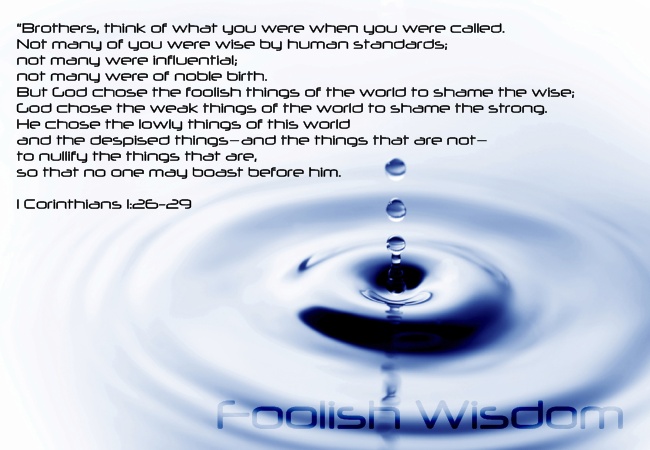
My absolute favorite passage of Scripture is found in 1 Corinthians 1:18-29. The second half of this segment can be read in my blog title-header. However, I would like to put here the first half, as I think it is appropriate for the occasion. So 1 Corinthians 1:18-25:
For the message of the cross is foolishness to those who are perishing, but to us who are being saved it is the power of God. For it is written: "I will destroy the wisdom of the wise; the intelligence of the intelligent I will frustrate."
Where is the wise man? Where is the scholar? Where is the philosopher of this age? Has not God made foolish the wisdom of the world? For since in the wisdom of God the world through its wisdom did not know him, God was pleased through the foolishness of what was preached to save those who believe.
Jews demand miraculous signs and Greeks look for wisdom, but we preach Christ crucified: a stumbling block to Jews and foolishness to Gentiles, but to those whom God has called, both Jews and Greeks, Christ the power of God and the wisdom of God. For the foolishness of God is wiser than man's wisdom, and the weakness of God is stronger than man's strength.
Here it is. There are some very intelligent, very witty, very wise people who see Christianity as a path for the blind, for the deluded, for the helpless, for the fool. They look at the Christian faith and wonder how on earth anyone in their right mind could possibly believe such nonsense. There you go. What do you say to that?
There is always the path of, "well, they're just stupid and wrong, so there!" An easy path to take. It comes naturally after reading an attack on Christianity; we grow offended at their effrontery and, squaring off with their argument, charge in with fists flying, trying desperately to prove that they are the fools, not us. We need to know that we are wiser, cooler, and smarter than them, because then our ideas will naturally hold supremacy over theirs. We try to mock them into irrelevancy.
Is this the best response? Well, ponder this: the Bible says right there in 1 Corinthians 1 that we do not need to be as "wise" as those whom this world elevates as such. We are not to be naive, but there comes a time when we have to look at our faith, at all the super-intelligent cynics and their arguments, and be able to say "it's ok".
My favorite book of the Narnia series, The Silver Chair, contains a particular passage that blows me away every time I come to it. For context: Puddleglum the Marshwiggle and the two children have travelled across Narnia looking for a lost prince. They fall into a hole in the ground and end up in a large set of underground caverns--the realm of a beautiful queen (actually a witch). The witch discovers the three and begins trying to convince them that her realm is the only reality and that neither Narnia nor its king and savior Aslan actually exist. There is no sun except the lamp on the ceiling, she says, no life but that they see around them, no ruler save herself. Just as they are almost taken in, Puddleglum begins speaking:
"One word. All you've been saying is quite right, I shouldn't wonder. I'm a chap who always liked to know the worst and then put the best face I can on it. So I won't deny any of what you said. But there's one thing more to be said, even so. Suppose we have only dreamed, or made up, all those things--trees and grass and sun and moon and stars and Aslan himself. Suppose we have. Then all I can say is that, in that case, the made-up things seem a good deal more important than the real ones. Suppose this black pit of a kingdom of yours is the only world. Well, it strikes me as a pretty poor one. And that's a funny thing, when you come to think of it. We're just babies making up a game, if you're right. But four babies playing a game can make a play-world that licks your real world hollow. That's why I'm going to stand by the play-world. I'm on Aslan's side even if there isn't any Aslan to lead it. I'm going to live as like a Narnian as I can even if there isn't any Narnia."
His realization and dedication at this point ends up saving all of the heroes and defeating the witch's power.
It is important to be able to defend your faith against doubters. It is important to be able to argue your case winningly and well and without fear. However, there comes a point where God and his Story cease to make sense to those who do not follow it. It all seems like Foolishness to the wise, who will not embrace it. At this point, we must re-examine our faith not under the light of logic but under the light of God and his love and what he has done in us, and say yes, I am willing to stand against all logic and wisdom. I am going to stick with Jesus not because it makes sense or will turn out best for me in the end, but because Jesus and his salvation and his work in me has brought me to a place where I can never deny him. He has saved me, and I owe him my allegiance.
If we believe that God is real and his word is true, we can sit back and look at the arguments against Him, and these arguments will not get under our skin and worry and fret us until we flatten them. Instead, we can rest in the knowledge that...(and here I have nothing better to say than the words of two wiser people than I, and it is they I shall leave you with)
“At the end of the day, when I am lying in bed and I know the chances of any of our theology being exactly right are a million to one, I need to know that God has things figured out, that if my math is wrong we are still going to be okay..." - Don Miller, Blue Like Jazz
"Quick now, here, now, always--
A condition of complete simplicity
(Costing not less than everything)
And all shall be well
And all shall be well
And all manner of things shall be well"
--T.S. Eliot, Little Gidding
If I understand everything correctly, the point of this unit was to hear various worldviews (Christian and non) batted around by some very intelligent people. Hearing arguments for your faith can help you if you ever need to "give a reason for the hope that you have", as the Bible so aptly puts it. Hearing arguments against your faith can help you examine it more closely and (hopefully) grow stronger, as opposed to falling away. And then of course we have the blog posts for the purpose of dialoguing with the authors and ourselves.
My absolute favorite passage of Scripture is found in 1 Corinthians 1:18-29. The second half of this segment can be read in my blog title-header. However, I would like to put here the first half, as I think it is appropriate for the occasion. So 1 Corinthians 1:18-25:
For the message of the cross is foolishness to those who are perishing, but to us who are being saved it is the power of God. For it is written: "I will destroy the wisdom of the wise; the intelligence of the intelligent I will frustrate."
Where is the wise man? Where is the scholar? Where is the philosopher of this age? Has not God made foolish the wisdom of the world? For since in the wisdom of God the world through its wisdom did not know him, God was pleased through the foolishness of what was preached to save those who believe.
Jews demand miraculous signs and Greeks look for wisdom, but we preach Christ crucified: a stumbling block to Jews and foolishness to Gentiles, but to those whom God has called, both Jews and Greeks, Christ the power of God and the wisdom of God. For the foolishness of God is wiser than man's wisdom, and the weakness of God is stronger than man's strength.
Here it is. There are some very intelligent, very witty, very wise people who see Christianity as a path for the blind, for the deluded, for the helpless, for the fool. They look at the Christian faith and wonder how on earth anyone in their right mind could possibly believe such nonsense. There you go. What do you say to that?
There is always the path of, "well, they're just stupid and wrong, so there!" An easy path to take. It comes naturally after reading an attack on Christianity; we grow offended at their effrontery and, squaring off with their argument, charge in with fists flying, trying desperately to prove that they are the fools, not us. We need to know that we are wiser, cooler, and smarter than them, because then our ideas will naturally hold supremacy over theirs. We try to mock them into irrelevancy.
Is this the best response? Well, ponder this: the Bible says right there in 1 Corinthians 1 that we do not need to be as "wise" as those whom this world elevates as such. We are not to be naive, but there comes a time when we have to look at our faith, at all the super-intelligent cynics and their arguments, and be able to say "it's ok".
My favorite book of the Narnia series, The Silver Chair, contains a particular passage that blows me away every time I come to it. For context: Puddleglum the Marshwiggle and the two children have travelled across Narnia looking for a lost prince. They fall into a hole in the ground and end up in a large set of underground caverns--the realm of a beautiful queen (actually a witch). The witch discovers the three and begins trying to convince them that her realm is the only reality and that neither Narnia nor its king and savior Aslan actually exist. There is no sun except the lamp on the ceiling, she says, no life but that they see around them, no ruler save herself. Just as they are almost taken in, Puddleglum begins speaking:
"One word. All you've been saying is quite right, I shouldn't wonder. I'm a chap who always liked to know the worst and then put the best face I can on it. So I won't deny any of what you said. But there's one thing more to be said, even so. Suppose we have only dreamed, or made up, all those things--trees and grass and sun and moon and stars and Aslan himself. Suppose we have. Then all I can say is that, in that case, the made-up things seem a good deal more important than the real ones. Suppose this black pit of a kingdom of yours is the only world. Well, it strikes me as a pretty poor one. And that's a funny thing, when you come to think of it. We're just babies making up a game, if you're right. But four babies playing a game can make a play-world that licks your real world hollow. That's why I'm going to stand by the play-world. I'm on Aslan's side even if there isn't any Aslan to lead it. I'm going to live as like a Narnian as I can even if there isn't any Narnia."
His realization and dedication at this point ends up saving all of the heroes and defeating the witch's power.
It is important to be able to defend your faith against doubters. It is important to be able to argue your case winningly and well and without fear. However, there comes a point where God and his Story cease to make sense to those who do not follow it. It all seems like Foolishness to the wise, who will not embrace it. At this point, we must re-examine our faith not under the light of logic but under the light of God and his love and what he has done in us, and say yes, I am willing to stand against all logic and wisdom. I am going to stick with Jesus not because it makes sense or will turn out best for me in the end, but because Jesus and his salvation and his work in me has brought me to a place where I can never deny him. He has saved me, and I owe him my allegiance.
If we believe that God is real and his word is true, we can sit back and look at the arguments against Him, and these arguments will not get under our skin and worry and fret us until we flatten them. Instead, we can rest in the knowledge that...(and here I have nothing better to say than the words of two wiser people than I, and it is they I shall leave you with)
“At the end of the day, when I am lying in bed and I know the chances of any of our theology being exactly right are a million to one, I need to know that God has things figured out, that if my math is wrong we are still going to be okay..." - Don Miller, Blue Like Jazz
"Quick now, here, now, always--
A condition of complete simplicity
(Costing not less than everything)
And all shall be well
And all shall be well
And all manner of things shall be well"
--T.S. Eliot, Little Gidding
Monday, March 2
Reading Jazz
Don Miller's Blue Like Jazz is not a comfortable book. People sense this within moments of picking it up. Both in my English class (where this book was assigned) and in the larger culture (gleaned from reviews on Amazon and the like), Miller's work has provoked not only some positive feedback but a fairly significant negative backlash. Unlike many books, the complaints do not stem from "this is boring" or "this is poorly written" or "this is trite", but rather "this is wrong". Miller really pushes the boundaries of conservative theology and ideology.
I don't mean to pick on anyone in my English class; I totally respect everyone's opinions. I'm just quoting here in order to have some material to dialogue with.
One student wrote: "Popular Christianity is not Christianity at all. I finished reading Don Miller's book, Blue Like Jazz, yesterday, and I notice his desire for Christianity to be cool...It is destructive when a Christian's walk is based on feeling."
Another student wrote: "I think Donald Miller is unfortunately one of those people who has succumbed to a feel-good religiosity, which is truly a shame because I think he would make such an amazing Christian. Hopefully he gets there someday."
I think these are all valid statements. A lot of Christians are wary of Miller's perspective. And sometimes his talk of "love", of "mysticism", of democrats and hippies, is disconcerting. As I said before, Miller is not one of those people you can skim over and say "well, that's nice". He is either terribly confused in his religious ideas, or he is amazingly clear in his insights. I am not a spiritual expert. I only wish to make a few points here:
1. How are we approaching Miller’s book? As I have said many times, I mainly dislike books on Christian living. I often wonder why people approach these books as if they are infallible manuals of how to live a better life. The person writing the book is not any more qualified to write on a subject then I am, save for the fact that he or she has done more research or had more experience than me. These people are not “higher Christians”, they are people just like everyone else. So it sometimes worries me that an author—sinful and human—is spiritually shepherding thousands of readers who take his or her word as true and trustworthy. All this to say, I think there is a tendency to approach Miller’s book rather like this: “Oh, here is a ‘Christian Living’ book. It must either be perfect and scripturally sound so that I can base my life on it, or it is totally wrong and I must throw out the whole mess.” Isn’t it completely plausible to imagine that a book written by a fallible human could contain both some wise, God-given insights and some misconceptions or confusions? Just because some of Miller’s ideas are more unusual, it does not mean that his book contains any fewer theological missteps than any other book out there. In fact, according to some, a lot of the most traditional Christian living books contain major misrepresentations of the true meaning of faith, etc. All that to say, if we approach Miller’s book expecting a doctrinally perfect guide to life second only to Scripture, then yes, we shall be gravely disappointed. If we approach the book not expecting to sift and weigh each individual idea on its own merit, we shall be gravely confused. And so on.
2. What is the purpose of Miller’s book? Blue Like Jazz seems rather more like a memoir than a book on how to live the Christian life. Writing a memoir, Miller is allowed to put anything he wants in there. It is, after all, about what he thinks, not about how you ought to think. I imagine that if any of us started writing down every thought, every quirk, every personal belief, we would sound as strange, as controversial, as deep, as immature, and—yes—even as wrong, as Miller.
3. How much of Miller’s work is as “out there” as it sounds? When we get offended or startled by a passage in Blue Like Jazz, we must, must examine whether that passage is contradicting Scripture, or simply our own traditional views of Scripture. For example, some people have freaked out about Miller living with and enjoying the company of hippies. At this point, we have to remember who Jesus hung out with. If we recoil at how Miller seeks to make Christianity relevant, we must reexamine how Jesus shared the gospel through parables designed for their relevancy with his audience.
A lot of people complain that Miller is throwing out organized doctrine, God’s justice, and the law, replacing them with a fluffy, mystical, “feel-good” God of love. I think we must be very careful in interpreting Miller’s words. Maybe he swings too far in one direction...Maybe others swing too far the opposite way. It is certainly going too far to judge whether or not Miller is a “true” Christian.
I guess it all comes down to: learn what you can from Miller, and leave the parts you can’t accept. It’s ok.
I don't mean to pick on anyone in my English class; I totally respect everyone's opinions. I'm just quoting here in order to have some material to dialogue with.
One student wrote: "Popular Christianity is not Christianity at all. I finished reading Don Miller's book, Blue Like Jazz, yesterday, and I notice his desire for Christianity to be cool...It is destructive when a Christian's walk is based on feeling."
Another student wrote: "I think Donald Miller is unfortunately one of those people who has succumbed to a feel-good religiosity, which is truly a shame because I think he would make such an amazing Christian. Hopefully he gets there someday."
I think these are all valid statements. A lot of Christians are wary of Miller's perspective. And sometimes his talk of "love", of "mysticism", of democrats and hippies, is disconcerting. As I said before, Miller is not one of those people you can skim over and say "well, that's nice". He is either terribly confused in his religious ideas, or he is amazingly clear in his insights. I am not a spiritual expert. I only wish to make a few points here:
1. How are we approaching Miller’s book? As I have said many times, I mainly dislike books on Christian living. I often wonder why people approach these books as if they are infallible manuals of how to live a better life. The person writing the book is not any more qualified to write on a subject then I am, save for the fact that he or she has done more research or had more experience than me. These people are not “higher Christians”, they are people just like everyone else. So it sometimes worries me that an author—sinful and human—is spiritually shepherding thousands of readers who take his or her word as true and trustworthy. All this to say, I think there is a tendency to approach Miller’s book rather like this: “Oh, here is a ‘Christian Living’ book. It must either be perfect and scripturally sound so that I can base my life on it, or it is totally wrong and I must throw out the whole mess.” Isn’t it completely plausible to imagine that a book written by a fallible human could contain both some wise, God-given insights and some misconceptions or confusions? Just because some of Miller’s ideas are more unusual, it does not mean that his book contains any fewer theological missteps than any other book out there. In fact, according to some, a lot of the most traditional Christian living books contain major misrepresentations of the true meaning of faith, etc. All that to say, if we approach Miller’s book expecting a doctrinally perfect guide to life second only to Scripture, then yes, we shall be gravely disappointed. If we approach the book not expecting to sift and weigh each individual idea on its own merit, we shall be gravely confused. And so on.
2. What is the purpose of Miller’s book? Blue Like Jazz seems rather more like a memoir than a book on how to live the Christian life. Writing a memoir, Miller is allowed to put anything he wants in there. It is, after all, about what he thinks, not about how you ought to think. I imagine that if any of us started writing down every thought, every quirk, every personal belief, we would sound as strange, as controversial, as deep, as immature, and—yes—even as wrong, as Miller.
3. How much of Miller’s work is as “out there” as it sounds? When we get offended or startled by a passage in Blue Like Jazz, we must, must examine whether that passage is contradicting Scripture, or simply our own traditional views of Scripture. For example, some people have freaked out about Miller living with and enjoying the company of hippies. At this point, we have to remember who Jesus hung out with. If we recoil at how Miller seeks to make Christianity relevant, we must reexamine how Jesus shared the gospel through parables designed for their relevancy with his audience.
A lot of people complain that Miller is throwing out organized doctrine, God’s justice, and the law, replacing them with a fluffy, mystical, “feel-good” God of love. I think we must be very careful in interpreting Miller’s words. Maybe he swings too far in one direction...Maybe others swing too far the opposite way. It is certainly going too far to judge whether or not Miller is a “true” Christian.
I guess it all comes down to: learn what you can from Miller, and leave the parts you can’t accept. It’s ok.
Subscribe to:
Posts (Atom)

