I want this post to be a kind of summation of my closing thoughts on the Christian Apologetics unit in our English class. Appropriately, it also appears to be my 40th post--a nice, round number to close out a string of very long and thoughtful (if not exactly intelligent) posts...
If I understand everything correctly, the point of this unit was to hear various worldviews (Christian and non) batted around by some very intelligent people. Hearing arguments for your faith can help you if you ever need to "give a reason for the hope that you have", as the Bible so aptly puts it. Hearing arguments against your faith can help you examine it more closely and (hopefully) grow stronger, as opposed to falling away. And then of course we have the blog posts for the purpose of dialoguing with the authors and ourselves.
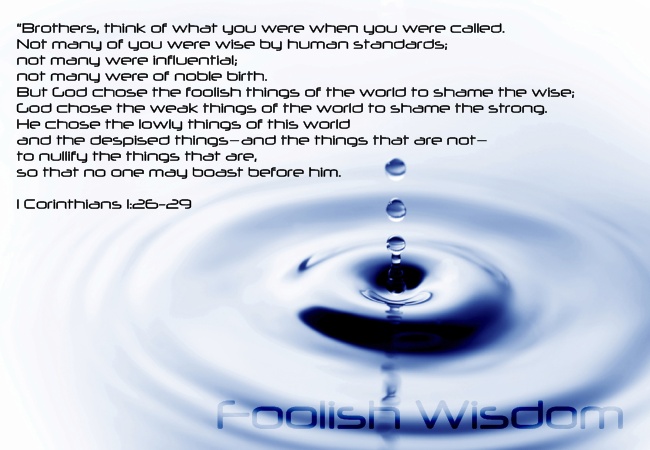
My absolute favorite passage of Scripture is found in 1 Corinthians 1:18-29. The second half of this segment can be read in my blog title-header. However, I would like to put here the first half, as I think it is appropriate for the occasion. So 1 Corinthians 1:18-25:
For the message of the cross is foolishness to those who are perishing, but to us who are being saved it is the power of God. For it is written: "I will destroy the wisdom of the wise; the intelligence of the intelligent I will frustrate."
Where is the wise man? Where is the scholar? Where is the philosopher of this age? Has not God made foolish the wisdom of the world? For since in the wisdom of God the world through its wisdom did not know him, God was pleased through the foolishness of what was preached to save those who believe.
Jews demand miraculous signs and Greeks look for wisdom, but we preach Christ crucified: a stumbling block to Jews and foolishness to Gentiles, but to those whom God has called, both Jews and Greeks, Christ the power of God and the wisdom of God. For the foolishness of God is wiser than man's wisdom, and the weakness of God is stronger than man's strength.
Here it is. There are some very intelligent, very witty, very wise people who see Christianity as a path for the blind, for the deluded, for the helpless, for the fool. They look at the Christian faith and wonder how on earth anyone in their right mind could possibly believe such nonsense. There you go. What do you say to that?
There is always the path of, "well, they're just stupid and wrong, so there!" An easy path to take. It comes naturally after reading an attack on Christianity; we grow offended at their effrontery and, squaring off with their argument, charge in with fists flying, trying desperately to prove that they are the fools, not us. We need to know that we are wiser, cooler, and smarter than them, because then our ideas will naturally hold supremacy over theirs. We try to mock them into irrelevancy.
Is this the best response? Well, ponder this: the Bible says right there in 1 Corinthians 1 that we do not need to be as "wise" as those whom this world elevates as such. We are not to be naive, but there comes a time when we have to look at our faith, at all the super-intelligent cynics and their arguments, and be able to say "it's ok".
My favorite book of the Narnia series, The Silver Chair, contains a particular passage that blows me away every time I come to it. For context: Puddleglum the Marshwiggle and the two children have travelled across Narnia looking for a lost prince. They fall into a hole in the ground and end up in a large set of underground caverns--the realm of a beautiful queen (actually a witch). The witch discovers the three and begins trying to convince them that her realm is the only reality and that neither Narnia nor its king and savior Aslan actually exist. There is no sun except the lamp on the ceiling, she says, no life but that they see around them, no ruler save herself. Just as they are almost taken in, Puddleglum begins speaking:
"One word. All you've been saying is quite right, I shouldn't wonder. I'm a chap who always liked to know the worst and then put the best face I can on it. So I won't deny any of what you said. But there's one thing more to be said, even so. Suppose we have only dreamed, or made up, all those things--trees and grass and sun and moon and stars and Aslan himself. Suppose we have. Then all I can say is that, in that case, the made-up things seem a good deal more important than the real ones. Suppose this black pit of a kingdom of yours is the only world. Well, it strikes me as a pretty poor one. And that's a funny thing, when you come to think of it. We're just babies making up a game, if you're right. But four babies playing a game can make a play-world that licks your real world hollow. That's why I'm going to stand by the play-world. I'm on Aslan's side even if there isn't any Aslan to lead it. I'm going to live as like a Narnian as I can even if there isn't any Narnia."
His realization and dedication at this point ends up saving all of the heroes and defeating the witch's power.
It is important to be able to defend your faith against doubters. It is important to be able to argue your case winningly and well and without fear. However, there comes a point where God and his Story cease to make sense to those who do not follow it. It all seems like Foolishness to the wise, who will not embrace it. At this point, we must re-examine our faith not under the light of logic but under the light of God and his love and what he has done in us, and say yes, I am willing to stand against all logic and wisdom. I am going to stick with Jesus not because it makes sense or will turn out best for me in the end, but because Jesus and his salvation and his work in me has brought me to a place where I can never deny him. He has saved me, and I owe him my allegiance.
If we believe that God is real and his word is true, we can sit back and look at the arguments against Him, and these arguments will not get under our skin and worry and fret us until we flatten them. Instead, we can rest in the knowledge that...(and here I have nothing better to say than the words of two wiser people than I, and it is they I shall leave you with)
“At the end of the day, when I am lying in bed and I know the chances of any of our theology being exactly right are a million to one, I need to know that God has things figured out, that if my math is wrong we are still going to be okay..." - Don Miller, Blue Like Jazz
"Quick now, here, now, always--
A condition of complete simplicity
(Costing not less than everything)
And all shall be well
And all shall be well
And all manner of things shall be well"
--T.S. Eliot, Little Gidding
skip to main |
skip to sidebar


About Me

- Megan
- I'm a tall teenager with a love for all things creative and beautiful.
Vocab I've Learned This Year (See related posts for definitions)
- Abrogate
- Abstemious
- Adumbrate
- Attrition
- Confabulate
- Confute
- Demagogue
- Edacious
- Eristic
- Farrago
- Fugacious
- Gelid
- Isochronal
- Jejune
- Lachrymose
- Lagniappe
- Littoral
- Macerate
- Martinet
- Medial
- Mendicant
- Nonpareil
- Picayune
- Polemical
- Prognosticator
- Roborant
- Sedulous
- Thurible
- Vituperate
What is the Media Corner? Focused on entertainment media, this side column will feature a different book, movie, and song each week. Enjoy!
This Week's Theme: Best of 2008
So as we head in to 2009, this seems like a good time to look back at some of the best media that I discovered in 2008 (not neccessarily produced in that year)
Books:
"Hitchhiker's Guide to the Galaxy" by Douglas Adams
Yes, Adams has graced this column already, so I won't go into great detail. All I can say is that I'm glad to have discovered these books.
"It Came From Within!" by Andy Stanley
Ok...I do not read Christian "self-help" books. Ever. I only read this one because I was required to--but I was pleasantly surprised. Basically, this book studies how attitudes such as anger and greed have unexpected roots in our hearts, and what to do about them. Fun and easy to read, but very compelling and easy to apply.
"Till We Have Faces" by C.S. Lewis
Sadly, I forgot to put this on my favorite books of all time list, where it definitely belongs. This book was stunning. I won't give away the plot, because that would spoil the emotional impact. But man, this book was quite a roller-coaster for me. Highly recommended.
"A Tree Grows In Brooklyn" by (I don't remember lol)
I feel obligated to put this book on the list because it is so well written and powerful. However, I did find that this book--a classic in every way--made me feel depressed every time I started reading...For books about people's depressing lives in New York, I preferred Chaim Potok's books. Try "The Chosen" or "My Name is Asher Lev" for a start. Don't read "In the Beginning" unless you want to be really depressed...
Movies:
The Dark Knight
So you've all heard about--and probably seen--this summer blockbuster, the second installment in Christopher Nolan's new Batman franchise. Just know that this movie is not for everyone...some people will just find it depressing and scary. I, for one, added it to my favorites list on the spot. Intense, but very deep.
We Are Marshall
For a long time, "Glory Road" had held firm as my favorite sports movie. But now it has been surpassed. "Marshall" avoids a lot of sports movie stereotypes, and did a very good thing when they cast Matthew what's-his-name as the head coach. Very inspiring and enjoyable.
Noelle
Being some little movie that a Christian family made from nothing, this Christmas story cannot really stand beside the Hollywood biggies. However, I must say that I was impressed--this movie captured a subtlety and power that almost every other Christian film barges right past. IMHO, this blows stuff like "Love Comes Softly" out of the water.
Music:
I discovered a lot of very good, if obscure, musicians in the latter part of this year. Please note that you can find all of these artists at Christianity Today's music website.
Steven Delopoulos
Just talked about him in the previous column
Ben Shive
This guy has done a lot of producing, writing, and instrumentation for big-name Christian artists (Chris Tomlin, Amy Grant, etc.) Just this year he came out with his first real album all by himself, virtually unheard of...and instantly Christianity Today picked it up as one of the 12 best albums of 2008. And boy does he deserve it. Great stuff, if rather untraditional.
Waterdeep
This group has released several albums, and their lead singer Don Chaffer has done several on his own. These people have amazing lyrics and great music--really classic rock and even some country-folk acoustic stuff. I love Don Chaffer's voice...but unfortunately a lot of their albums have his wife singing as well, and she sounds kind of harsh and whiney. So I mostly go for albums where Don does all the singing. Anyway, great people. Not for light listening, but when you want something really deep to chew on.
Andrew Peterson
This guy does fairly gentle music with solid lyrics. He teams up with Ben Shive a lot, and is more comperable to him than to Delopoulos or Waterdeep. His voice takes a lot of conditioning to get used to--it is very nasally--but eventually his quality shines through
Books:
"Hitchhiker's Guide to the Galaxy" by Douglas Adams
Yes, Adams has graced this column already, so I won't go into great detail. All I can say is that I'm glad to have discovered these books.
"It Came From Within!" by Andy Stanley
Ok...I do not read Christian "self-help" books. Ever. I only read this one because I was required to--but I was pleasantly surprised. Basically, this book studies how attitudes such as anger and greed have unexpected roots in our hearts, and what to do about them. Fun and easy to read, but very compelling and easy to apply.
"Till We Have Faces" by C.S. Lewis
Sadly, I forgot to put this on my favorite books of all time list, where it definitely belongs. This book was stunning. I won't give away the plot, because that would spoil the emotional impact. But man, this book was quite a roller-coaster for me. Highly recommended.
"A Tree Grows In Brooklyn" by (I don't remember lol)
I feel obligated to put this book on the list because it is so well written and powerful. However, I did find that this book--a classic in every way--made me feel depressed every time I started reading...For books about people's depressing lives in New York, I preferred Chaim Potok's books. Try "The Chosen" or "My Name is Asher Lev" for a start. Don't read "In the Beginning" unless you want to be really depressed...
Movies:
The Dark Knight
So you've all heard about--and probably seen--this summer blockbuster, the second installment in Christopher Nolan's new Batman franchise. Just know that this movie is not for everyone...some people will just find it depressing and scary. I, for one, added it to my favorites list on the spot. Intense, but very deep.
We Are Marshall
For a long time, "Glory Road" had held firm as my favorite sports movie. But now it has been surpassed. "Marshall" avoids a lot of sports movie stereotypes, and did a very good thing when they cast Matthew what's-his-name as the head coach. Very inspiring and enjoyable.
Noelle
Being some little movie that a Christian family made from nothing, this Christmas story cannot really stand beside the Hollywood biggies. However, I must say that I was impressed--this movie captured a subtlety and power that almost every other Christian film barges right past. IMHO, this blows stuff like "Love Comes Softly" out of the water.
Music:
I discovered a lot of very good, if obscure, musicians in the latter part of this year. Please note that you can find all of these artists at Christianity Today's music website.
Steven Delopoulos
Just talked about him in the previous column
Ben Shive
This guy has done a lot of producing, writing, and instrumentation for big-name Christian artists (Chris Tomlin, Amy Grant, etc.) Just this year he came out with his first real album all by himself, virtually unheard of...and instantly Christianity Today picked it up as one of the 12 best albums of 2008. And boy does he deserve it. Great stuff, if rather untraditional.
Waterdeep
This group has released several albums, and their lead singer Don Chaffer has done several on his own. These people have amazing lyrics and great music--really classic rock and even some country-folk acoustic stuff. I love Don Chaffer's voice...but unfortunately a lot of their albums have his wife singing as well, and she sounds kind of harsh and whiney. So I mostly go for albums where Don does all the singing. Anyway, great people. Not for light listening, but when you want something really deep to chew on.
Andrew Peterson
This guy does fairly gentle music with solid lyrics. He teams up with Ben Shive a lot, and is more comperable to him than to Delopoulos or Waterdeep. His voice takes a lot of conditioning to get used to--it is very nasally--but eventually his quality shines through
Research Paper
Working Bibliography:
Books:
Botkin, Isaac. Outside Hollywood: The Young Christian’s Guide to Vocational Filmmaking. San Antonio: Vision Forum Ministries, 2007.
Print sources from an online database:
Guthrie, Stan. "Entertaining Truth." Christianity Today 50.12 (Dec. 2006): 62-63. Academic Search Premier. EBSCO. 26 Oct. 2008
http://ezproxy.mylibrary.us:2051/login.aspx?direct=true&db=aph&AN=23361368&site=ehost-live
Rosin, Hanna. "Can Jesus Save Hollywood?." Atlantic Monthly (10727825) 296.5 (Dec. 2005): 161-168. Academic Search Premier. EBSCO. 5 Nov. 2008 http://ezproxy.mylibrary.us:2051/login.aspx?direct=true&db=aph&AN=18848651&site=ehost-live.
Web Articles:
“Three Views of Hollywood.” Advent Film Group. 2008. 20 October 2008.
http://www.adventfilmgroup.com/Three_Views_of_Hollywood.html
Bowen, Barry. “A History of Christian Films.” Christian Headlines. 2003. 12 November 2008.
http://www.christianheadlines.com/filmhistory.html
Christiano, Dave and Bowen, Barry. “A History and Overview of Christian Films.” Christian Films.com. 2008. 12 November 2008. http://www.christianfilms.com/overview.htm
Taylor, W. David. “What’s A Christian Movie? (In Four Parts).” Christianity Today Movies (2004) 24 October 2008.
(Part 1)http://www.christianitytoday.com/movies/commentaries/goodchristianmovie.html (Part 2) http://www.christianitytoday.com/movies/commentaries/honesttogodtruthaboutmovies.html
(Part 3) http://www.christianitytoday.com/movies/commentaries/mereentertainment.html
(Part 4) http://www.christianitytoday.com/movies/commentaries/violenceprofanitynudity.html
White, David. “Christian Film Making...Oxymoron?” Christian Cinema. 2005. 21 October 2008.
http://www.christiancinema.com/catalog/newsdesk_info.php?newsdesk_id=132
Transcripts of Interviews/E-mail Exchanges:
Gresham, Douglas. “Christians in Cinema.” Interview. Christian Cinema. Eds. Angela Walker. 2008. 23 October 2008.
http://christianmovienews.com/christians-in-cinema-douglas-gresham/
Harvey, Angela & Swartzwelder, Rik. “Should Films Be Faith-Explicit? (In Four Parts).” Christianity Today Movies (2005) 24 October 2008.
(Part 1) http://www.christianitytoday.com/movies/commentaries/filmsfaithexplicit1.html (Part 2) http://www.christianitytoday.com/movies/commentaries/filmsfaithexplicit2.html (Part 3) http://www.christianitytoday.com/movies/commentaries/filmsfaithexplicit3.html (Part 4) http://www.christianitytoday.com/movies/commentaries/filmsfaithexplicit4.html
Schroeder, Zena. “Interview With Zena Dell Schroeder.” Interview. Maryann Diorio Blog. 2006. 21 October 2008. http://www.maryanndiorio.com/blog/archives/general/000312.php
Books:
Botkin, Isaac. Outside Hollywood: The Young Christian’s Guide to Vocational Filmmaking. San Antonio: Vision Forum Ministries, 2007.
Print sources from an online database:
Guthrie, Stan. "Entertaining Truth." Christianity Today 50.12 (Dec. 2006): 62-63. Academic Search Premier. EBSCO. 26 Oct. 2008
http://ezproxy.mylibrary.us:2051/login.aspx?direct=true&db=aph&AN=23361368&site=ehost-live
Rosin, Hanna. "Can Jesus Save Hollywood?." Atlantic Monthly (10727825) 296.5 (Dec. 2005): 161-168. Academic Search Premier. EBSCO. 5 Nov. 2008 http://ezproxy.mylibrary.us:2051/login.aspx?direct=true&db=aph&AN=18848651&site=ehost-live.
Web Articles:
“Three Views of Hollywood.” Advent Film Group. 2008. 20 October 2008.
http://www.adventfilmgroup.com/Three_Views_of_Hollywood.html
Bowen, Barry. “A History of Christian Films.” Christian Headlines. 2003. 12 November 2008.
http://www.christianheadlines.com/filmhistory.html
Christiano, Dave and Bowen, Barry. “A History and Overview of Christian Films.” Christian Films.com. 2008. 12 November 2008. http://www.christianfilms.com/overview.htm
Taylor, W. David. “What’s A Christian Movie? (In Four Parts).” Christianity Today Movies (2004) 24 October 2008.
(Part 1)http://www.christianitytoday.com/movies/commentaries/goodchristianmovie.html (Part 2) http://www.christianitytoday.com/movies/commentaries/honesttogodtruthaboutmovies.html
(Part 3) http://www.christianitytoday.com/movies/commentaries/mereentertainment.html
(Part 4) http://www.christianitytoday.com/movies/commentaries/violenceprofanitynudity.html
White, David. “Christian Film Making...Oxymoron?” Christian Cinema. 2005. 21 October 2008.
http://www.christiancinema.com/catalog/newsdesk_info.php?newsdesk_id=132
Transcripts of Interviews/E-mail Exchanges:
Gresham, Douglas. “Christians in Cinema.” Interview. Christian Cinema. Eds. Angela Walker. 2008. 23 October 2008.
http://christianmovienews.com/christians-in-cinema-douglas-gresham/
Harvey, Angela & Swartzwelder, Rik. “Should Films Be Faith-Explicit? (In Four Parts).” Christianity Today Movies (2005) 24 October 2008.
(Part 1) http://www.christianitytoday.com/movies/commentaries/filmsfaithexplicit1.html (Part 2) http://www.christianitytoday.com/movies/commentaries/filmsfaithexplicit2.html (Part 3) http://www.christianitytoday.com/movies/commentaries/filmsfaithexplicit3.html (Part 4) http://www.christianitytoday.com/movies/commentaries/filmsfaithexplicit4.html
Schroeder, Zena. “Interview With Zena Dell Schroeder.” Interview. Maryann Diorio Blog. 2006. 21 October 2008. http://www.maryanndiorio.com/blog/archives/general/000312.php
No comments:
Post a Comment